Can Jewelers Tell If a Diamond Is Lab Grown?
The simple answer is yes—but not by visual inspection alone.
Modern laboratory-grown diamonds possess the same:
- Carbon crystal structure
- Mohs hardness rating of 10
- Optical brilliance
- Fire and scintillation
- Thermal conductivity
As a result, even highly experienced jewelers typically cannot distinguish a natural diamond from a lab-grown diamond simply by looking at it.
Instead, professional identification requires specialized gemological equipment and certification verification.
Why Lab Grown Diamonds Look Identical to Natural Diamonds
Both natural and laboratory-created diamonds are real diamonds.
Their atomic structure consists entirely of crystallized carbon arranged in a cubic lattice.
Shared Physical Properties
| Property | Natural Diamond | Lab Grown Diamond |
|---|---|---|
| Chemical Composition | Carbon (C) | Carbon (C) |
| Hardness | 10 Mohs | 10 Mohs |
| Refractive Index | 2.42 | 2.42 |
| Thermal Conductivity | Extremely High | Extremely High |
| Optical Brilliance | Identical | Identical |
| Durability | Excellent | Excellent |
Because these measurable properties are effectively identical, visual examination alone is insufficient.
Specialized Equipment Used to Identify Lab Grown Diamonds
Professional gemological laboratories utilize advanced detection systems to identify growth patterns and trace elements.
Common Detection Technologies
Spectroscopy
Spectroscopy evaluates how a diamond interacts with specific wavelengths of light.
Indicators may reveal:
- HPHT growth characteristics
- CVD growth patterns
- Nitrogen concentration differences
- Crystal growth anomalies
Diamond Screening Machines
Industry-standard screening devices can rapidly separate natural diamonds from potential laboratory-grown diamonds.
Examples include:
- DiamondSure
- DiamondView
- GIA screening instruments
- Advanced UV fluorescence scanners
Microscopic Analysis
High-powered microscopes can identify:
- Metallic inclusions
- Growth zoning
- Internal crystal structures
- Laboratory growth signatures
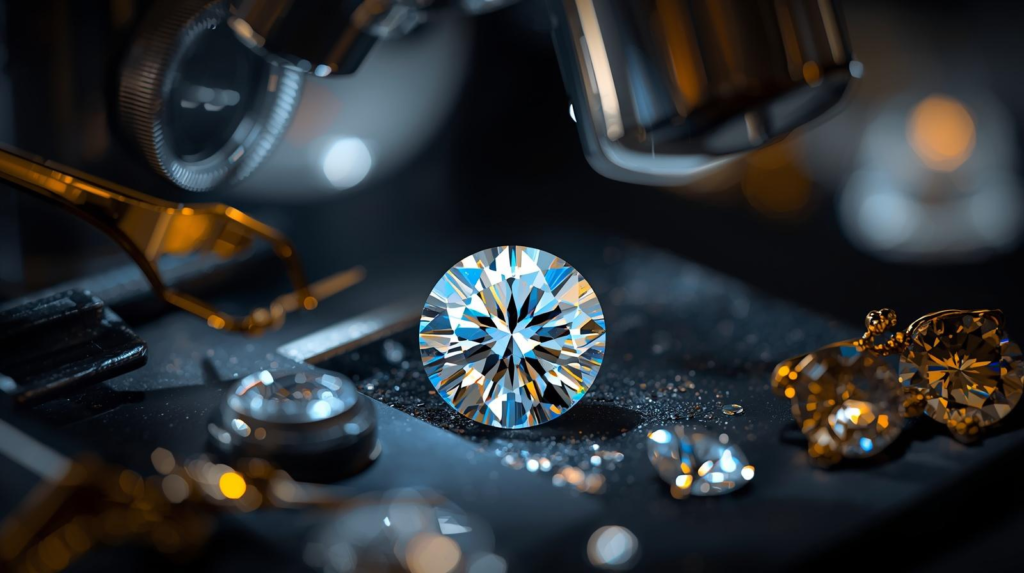
Laser Inscriptions: One of the Easiest Identification Methods
Many certified diamonds feature microscopic laser inscriptions on the girdle.
These inscriptions may include:
- GIA Report Number
- IGI Report Number
- Growth origin indicators
- Serial identification codes
A jeweler using magnification can often verify the stone’s certification and origin by referencing the inscription against the issuing laboratory database.
For buyers seeking exclusive lab-grown inventory, loose stones, and engagement ring configurations, visit:
https://www.ebay.com/str/dubaijewelfactory
Detection Technology in 2026
As of 2026, diamond authentication technology has become increasingly sophisticated.
Current Industry Methods
| Technology | Purpose | Detection Accuracy |
| Spectroscopy | Growth Origin Analysis | Extremely High |
| UV Fluorescence Mapping | Crystal Pattern Detection | High |
| Photoluminescence Testing | Trace Element Analysis | Very High |
| Laser Inscription Verification | Certification Validation | Very High |
| AI-Assisted Screening Systems | Batch Diamond Analysis | Extremely High |
Modern retail jewelers increasingly utilize AI-assisted screening systems to improve identification efficiency and consumer confidence.
Consumer Myth: “Lab Diamonds Are Fake”
One of the most common misconceptions is that laboratory-grown diamonds are imitation stones.
Reality
Lab-grown diamonds are:
- Real diamonds
- Chemically identical to mined diamonds
- Physically identical to mined diamonds
- Optically identical to mined diamonds
They are not:
- Cubic zirconia
- Glass
- Crystal simulants
- Moissanite
The primary distinction is origin, not composition.
How to Order Your Custom Ring in 3 Steps
Step 1: Compare Custom Rings in Dubai
Choose your preferred:
- Diamond shape
- Setting style
- Metal type
- Budget range
Step 2: See Certified Diamonds Collection
Select from:
- Natural diamonds
- Lab-grown diamonds
- Loose certified stones
- Custom sourcing requests
Step 3: Approve Design & Production
Receive:
- CAD rendering
- Final approval
- Manufacturing
- Fully insured worldwide delivery
Frequently Asked Questions
Can jewelers tell lab diamonds immediately?
No. Most jewelers cannot determine whether a diamond is lab-grown through visual inspection alone. Specialized testing equipment is typically required.
Are lab diamonds detectable after being set in jewelry?
Yes. Advanced gemological equipment can identify laboratory-grown diamonds even after they are mounted in rings or other jewelry.
Do all lab grown diamonds have laser inscriptions?
Not all, but many certified lab-grown diamonds feature microscopic laser inscriptions linked to their grading reports.
Is a lab grown diamond considered a real diamond?
Yes. A lab-grown diamond is a real diamond with the same chemical, physical, and optical properties as a mined diamond.