 USD
USD  AED (AED AED)
 Euro (EUR €)
 GBP (GBP £)
 BHD (BHD BHD)
 AUD (AUD AUD)
 NZD (NZD NZ$)
 SAR (SAR ﷼)
 KWD (KWD د.ك)
 Canadian Dollar (CAD CA$)
 Omani Rial (OMR OMR)
 Singapore Dollar (SGD S$)

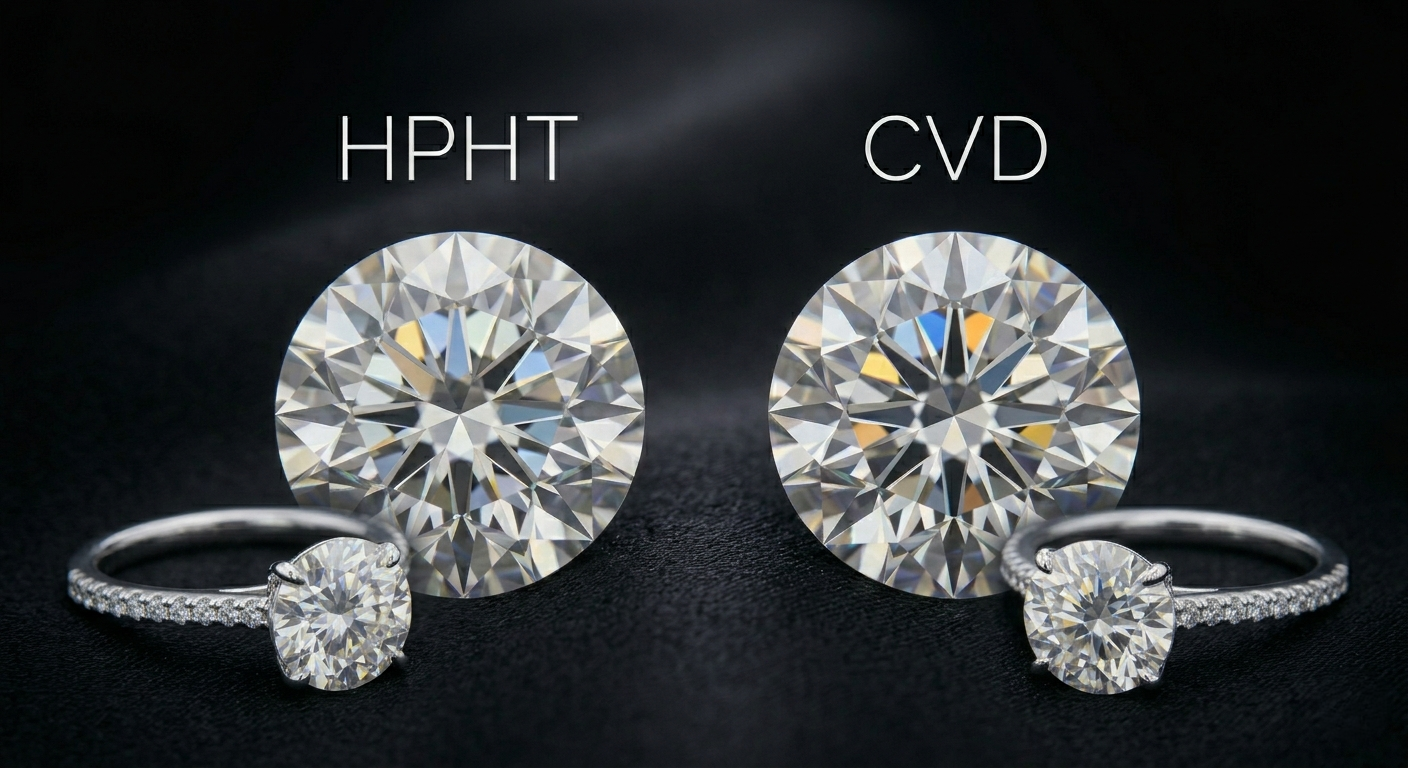
The lab-grown diamond revolution has completely shifted how the world buys luxury jewelry. Whether you are shopping from New York, London, or right here in Dubai, lab-grown diamonds offer identical optical, physical, and chemical properties to mined diamonds at a fraction of the cost.
However, when browsing for the perfect stone, you will instantly encounter two industry terms: HPHT and CVD.
While both methods produce genuine, certified diamonds, the manufacturing processes, growth patterns, and pricing structures vary. This comprehensive guide breaks down the technical differences to help you make an informed investment.
What HPHT Means (High Pressure High Temperature)
The HPHT method is the original technology used to create laboratory diamonds, dating back to the 1950s. This process directly replicates the extreme geological environment found deep within the Earth’s mantle.
- The Process: A small diamond seed is placed into a specialized press along with a carbon source (such as graphite) and a metallic catalyst solvent (typically iron, nickel, or cobalt).
- The Environment: The machine subjects the chamber to pressures exceeding 60,000 atmospheres and temperatures topping 1,500°C.
- The Growth: Under these intense conditions, the carbon source melts into the metallic flux, dissolves, and crystallizes atom-by-atom around the seed to form a rough cuboctahedron diamond crystal over a matter of weeks.
What CVD Means (Chemical Vapor Deposition)
The CVD method is a modern, highly precise technique adapted from the semiconductor industry that grows diamonds in an entirely different environmental setup.
- The Process: A thin slice of a diamond seed is placed into a vacuum sealing chamber.
- The Environment: The chamber is filled with a carbon-rich gas mixture (typically methane and hydrogen) and ionized into a plasma state using microwaves or lasers at around 800°C to 1,000°C.
- The Growth: The plasma breaks the molecular bonds of the gas, releasing pure carbon atoms. These atoms rain down continuously onto the diamond seed plate, layering flat, atom-by-atom, to grow a tabular, cube-shaped rough diamond crystal.
Manufacturing Comparison
The physical layout of the growth chambers dictates the crystal structure of the rough stone. This distinction affects how master cutters handle the raw material.
- HPHT Growth Geometry: Grows in a cuboctahedron shape with 14 growth directions. This multidirectional growth requires specific cutting expertise but yields highly dense, robust crystals.
- CVD Growth Geometry: Grows in a tabular cube shape with 1 single growth direction (upward). This linear layering can sometimes introduce minute structural stress lines, which are typically eliminated during the professional laser-cutting and faceting process.
Quality Differences: Color, Clarity, and Strain
A common misconception is that one method is inherently superior to the other. In reality, both methods consistently yield high-gem-quality stones, though they face different technical challenges during growth.
Color Profiles
- HPHT: Historically prone to a yellowish tint due to ambient nitrogen impurities. Modern adjustments often introduce boron to neutralize this, resulting in exceptionally high colorless grades (D, E, F).
- CVD: Can develop a faint brown or gray tint due to localized fluctuations in the gas plasma chamber. To correct this, many CVD diamonds undergo a post-growth HPHT treatment to permanently cure the color to a brilliant, pristine white.
Clarity Profiles
- HPHT Inclusions: May contain microscopic metallic inclusions from the iron/nickel flux catalyst. If massive, these can occasionally display slight magnetic properties, though gem-quality stones pass strict certification limits.
- CVD Inclusions: May exhibit tiny dark carbon pinpoint inclusions if graphitization occurs during the vapor rain phase. They are entirely non-magnetic.
Price Differences and Market Dynamics
When evaluating HPHT vs CVD diamonds, you will notice distinct wholesale and retail pricing trends based on carat weight and manufacturing yield.
- Under 1.00 Carat: CVD is exceptionally cost-effective to scale in large batches, making it the dominant choice for accent stones, eternity bands, and small stud earrings.
- 2.00 to 5.00+ Carats: HPHT setups excel at growing large, consistently colorless rough crystals. Consequently, premium, large-carat solitaire engagement rings frequently feature HPHT stones to ensure maximum color purity without needing post-growth alterations.
| Feature / Metric | HPHT Diamonds | CVD Diamonds |
| Growth Method | Mechanical pressure & thermal heat | Chemical gas plasma deposition |
| Catalyst Material | Molten metal solvent (Iron/Nickel) | Methane & Hydrogen gas |
| Growth Shape | Cuboctahedron (14 growth faces) | Tabular Cube (1 growth face) |
| Typical Inclusions | Microscopic flux metallic pinpoints | Dark non-metallic carbon spots |
| Post-Growth Tweak | Rarely required for color | Frequently treated with heat to remove brown tints |
| Best Suited For | Ultra-colorless large solitaires (2ct+) | Fine fashion jewelry & small accent layouts |
Which Is Better?
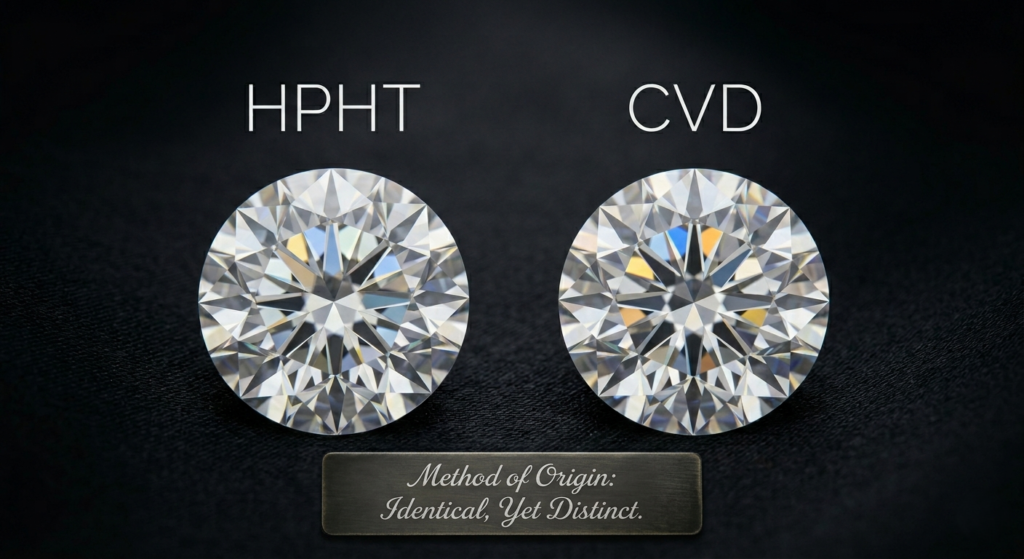
Neither is universally better; they are simply different pathways to the exact same physical destination. Once a diamond is fully cut and polished, it is impossible to distinguish an HPHT diamond from a CVD diamond with the naked eye or a standard jeweler’s loupe.
Only advanced spectroscopic lab equipment used by institutions like the GIA or IGI can identify the growth methodology. Your choice should come down to the specific grading metrics of the individual stone—prioritizing Cut, Color, and Clarity over the acronym on its certificate.
Where to Buy Certified Diamonds in Dubai
If you are sourcing fine jewelry worldwide, buying directly from Dubai offers unmatched trade advantages. Capri Gold – Dubai Jewel Factory, operating out of the premium Gold & Diamond Park in Dubai, UAE, provides direct-from-factory pricing on custom bridal creations.
Our infrastructure bridges the best of both gemstone worlds:
- On Our Website: Explore our premium global portfolio featuring both ultra-rare natural diamonds and pristine lab-grown statement pieces.
- On Our Global eBay Store: Looking exclusively for certified, high-grade lab-grown diamond jewelry? Visit the official Dubai Jewel Factory eBay Store for direct checkout, comprehensive consumer protections, and global logistics.
Why Global Clients Choose Dubai Jewel Factory
- Automatic Value-Added Savings: Our brand-new system applies targeted digital coupon codes directly to your cart at checkout.
- Exclusive Global Launch Promotional Code: Enter special code SPARKLE20 at checkout for an immediate 20% off your order.
- Complimentary Premium Enhancements: Every order includes free tracked worldwide shipping (serving the USA, Europe, and the UAE) alongside complimentary custom inner-band laser engraving for a personalized touch.
How to Order Your Ring in 3 Steps
- Select Your Base Stone: Choose between certified HPHT/CVD lab diamonds or natural options on our platforms.
- Personalize Your Settings: Provide your exact ring size and your custom text for our complimentary laser engraving service.
- Checkout with Automatic Discounts: Apply code SPARKLE20 or let our smart cart automatically deploy active rewards before secure global dispatch.
💡 Join the Inner Circle: Subscribe to our official newsletter today to unlock private VIP collections, early launch previews, and seasonal high-tier coupon codes tailored for our international clientele.
FAQ Section
Are HPHT and CVD diamonds real diamonds?
Yes. Both HPHT and CVD diamonds are 100% real diamonds. They possess the exact chemical (pure carbon), physical, and optical attributes as natural stones formed underground. They carry official gemstone certifications from world-renowned labs like the IGI and GIA.
Do CVD or HPHT diamonds fade or turn cloudy over time?
No. Because they share the identical crystalline structure of natural diamond blocks, neither HPHT nor CVD diamonds will ever fade, discolor, cloud, or lose their brilliance. Their fire and scintillation remain permanent for life.
Which lab-grown diamond process is more expensive?
At a wholesale production level, HPHT machinery requires significantly more energy and heavy machinery setups, making large-carat colorless rough stones slightly scarcer. However, at a retail level, individual stone pricing depends on the final 4Cs cut grade rather than the underlying technology used to grow the stone.
Can an appraiser tell if my diamond is CVD or HPHT?
A standard retail jeweler using traditional loupes or thermal diamond testers cannot distinguish between CVD and HPHT, nor can they tell them apart from a mined diamond. Differentiating the growth method requires specialized photoluminescence spectroscopy equipment found inside major grading laboratories.